

Generative AI has moved from pilot project to production infrastructure across banking and insurance in barely two years. AI-powered customer support now handles routine account queries, underwriting copilots draft first-pass risk memos, fraud detection systems flag anomalous transactions in real time, and claims automation triages first-notice-of-loss reports before a human adjuster opens the file. Credit decision support tools rank applicants, financial advisory assistants draft portfolio recommendations, and internal AI copilots — alongside AI coding assistants embedded in engineering workflows — now sit inside core operations rather than at the edges of them.
Every one of these institutions already runs a Model Risk Management program, typically anchored in SR 11-7 and equivalent supervisory guidance issued more than a decade ago. Those frameworks remain essential, and they are not going away. But they were built to govern static, predictive models — not adaptive, conversational, autonomous AI. That gap is why AI Governance for Banks has become a board-level priority rather than a checkbox on the model validation calendar, and why insurers, close behind, face the same reckoning.
Understanding Traditional Model Risk Management
Model Risk Management, as most banks and insurers practice it today, was designed around a specific kind of artifact: a model with defined inputs, a fixed set of parameters, and a measurable, repeatable output. MRM programs typically cover model validation, documentation, version management, formal approval workflows, periodic performance testing, bias assessments, and independent model reviews conducted on a set cadence — annually, or when a material change triggers a re-review. A model inventory sits underneath all of it, so that every model in production is known, tiered by risk, and accounted for.
This structure, grounded in guidance such as SR 11-7, OCC supervisory expectations, and Basel principles on operational risk, has worked well for the models it was built for: credit scoring, anti-money-laundering detection, fraud scoring, pricing models, and risk forecasting engines. These models are validated once, deployed, and monitored against stable performance thresholds until the next scheduled review. Behavior between reviews is, by design, supposed to stay put.
Why AI Has Changed the Risk Landscape
Large language models, generative AI applications, AI agents, and the retrieval-augmented generation (RAG) pipelines that feed them behave nothing like that. They reason dynamically, call external tools, hold memory across sessions, ingest third-party APIs and live knowledge retrieval, and increasingly operate as multi-agent systems where one AI system delegates work to another. Their behavior can shift meaningfully between one prompt and the next, without any new model version ever being deployed.
That shift introduces risk categories legacy MRM was never built to see: hallucinations, prompt injection, jailbreak attacks, tool poisoning, AI supply chain risk, sensitive data leakage, toxic or unsafe outputs, autonomous decisions taken without a human in the loop, runtime drift, context manipulation, and silent behavior changes triggered by a third-party foundation model update the bank never requested. None of these map cleanly onto a validate-once, monitor-quarterly cadence, because the system under governance is no longer just a model — it is a live combination of prompts, retrieved context, tools, memory, and a foundation model the institution does not control but remains fully accountable for.
Why These Challenges Extend Beyond Banking to Insurance
Although banking is under the most immediate pressure, insurers are working through nearly identical problems. AI-assisted underwriting, claims automation and claims copilots, fraud investigation tools, customer service chatbots, agentic claims processing, risk assessment models, pricing recommendation engines, and policy servicing assistants are all now live in production insurance workflows.
Insurers face additional layers on top of the risks banks already contend with: incorrect underwriting recommendations, hallucinated policy guidance handed to a policyholder as fact, bias in claims decisions, exposure of personally identifiable and health information, AI-generated customer communications that create regulatory or reputational exposure, prompt attacks against claims-facing chatbots, runtime drift in pricing models, and explainability requirements from state and national regulators that a black-box LLM cannot easily satisfy. AI Governance for Insurance ultimately requires the same continuous monitoring, policy enforcement, runtime security, auditability, and full-lifecycle governance that banking now needs — applied to underwriting, claims, and policy servicing instead of lending and payments.
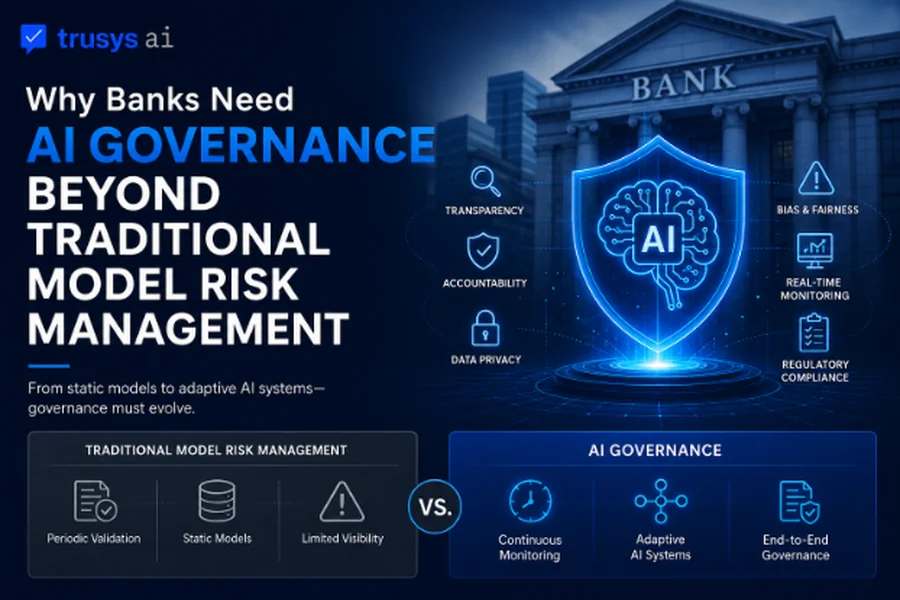
Traditional Model Risk Management vs AI Governance
The two disciplines are complementary, not competing — but they cover fundamentally different ground:
| Model Risk Management | AI Governance |
|---|---|
| Static, deterministic models | Dynamic, probabilistic AI systems |
| Periodic validation (annual / triggered) | Continuous, real-time monitoring |
| Model-centric scope | Full AI lifecycle: prompts, agents, tools, memory, data |
| Documentation-based evidence | Runtime observability and behavioral logs |
| Manual, human-led reviews | Automated policy enforcement at runtime |
| Offline, pre-deployment testing | Live production monitoring and drift detection |
| Limited audit trails | Complete, queryable AI audit trails |
| Accuracy and performance metrics | Behavior, intent, and output monitoring |
| Internally built models | Third-party and foundation model oversight |
| No prompt-level governance | Prompt monitoring and injection defense |
| No AI agent oversight | AI Agent Governance across tool use and memory |
| Limited security scope | Runtime AI security and adversarial testing |
The pattern across every row is the same: MRM was built for a world where a model’s behavior was fixed between reviews. AI Governance exists because that assumption no longer holds. It doesn’t replace model validation — it extends oversight to the layers MRM was never designed to reach: prompts, agents, memory, tools, and the live behavior of systems built on models the institution didn’t train.
The New AI Risks Financial Institutions Must Govern
Hallucinations
An LLM generates plausible but false output — a fabricated policy clause, an invented regulatory citation, a wrong loan term stated with total confidence. In banking this shows up in credit memos and customer chat; in insurance, in hallucinated coverage or claims guidance handed directly to a policyholder. The control is continuous hallucination benchmarking and output evaluation, not a one-time accuracy test.
Prompt Injection and Jailbreak Attacks
Hidden instructions embedded in an email, document, or web page hijack an AI system’s behavior without the user’s knowledge; jailbreaks manipulate the model directly into ignoring its guardrails. A banking chatbot tricked into revealing account data, or a claims assistant coaxed into approving a fraudulent claim, are the same underlying failure. The control is runtime prompt monitoring and adversarial red-teaming mapped to frameworks like the OWASP LLM and Agentic AI Top 10.
Tool Poisoning and AI Agent Misbehavior
Agents that call external tools and APIs can be manipulated into misusing them — approving a transaction they shouldn’t, querying data outside their intended scope, or delegating a task to a compromised sub-agent. This is a distinctly agentic risk with no equivalent in a static credit model, and it demands AI Agent Governance: policy-level control over what an agent is permitted to do with the tools it has access to.
AI Memory, RAG, and Data Leakage Risks
Persistent agent memory and RAG knowledge bases can be poisoned with fabricated content that an agent later treats as verified fact, and sensitive data can leak into logs, prompts, or downstream outputs. In banking this touches account and transaction data; in insurance, health and claims records. Governance controls include memory and RAG integrity checks alongside PII- and PHI-aware runtime redaction.
Third-Party AI Supply Chain Risk and Runtime Drift
Foundation models from providers the institution doesn’t operate can update silently, shifting behavior on systems already in production — and even without an update, live AI systems drift as usage patterns and inputs evolve. Left ungoverned, this produces “shadow AI”: tools and agents running in the business without ever entering the AI inventory, and compliance violations that surface only after an incident or an examiner’s request. The control is continuous behavioral monitoring against an established baseline, not a fixed annual re-validation.
What an Enterprise AI Governance Platform Should Include
A dedicated AI Governance platform needs to cover ground no legacy MRM tool was built for:
- AI asset discovery and a living AI inventory across every model, agent, and tool in use
- A governance dashboard giving risk, compliance, and audit teams a single view across the estate
- Runtime monitoring, hallucination detection, and behavioral drift alerting
- Prompt monitoring, prompt security, and an AI firewall for inbound and outbound traffic
- Configurable guardrails and a policy engine, with human approval workflows for high-risk actions
- Explainability and AI observability suited to non-deterministic systems
- AI Agent Governance covering tool use, memory, and multi-agent delegation
- Compliance automation, audit logging, incident management, and regulator-ready reporting
- Oversight of third-party and foundation-model dependencies the institution doesn’t directly control
AI Governance and the Regulatory Landscape
Regulators are converging on the same expectation from different directions: lifecycle governance, not point-in-time validation. The EU AI Act classifies many banking and insurance use cases as high-risk, with conformity assessment and transparency obligations that run well past a model’s initial deployment. ISO/IEC 42001 gives organizations a certifiable AI management system standard, while the NIST AI Risk Management Framework’s Govern-Map-Measure-Manage structure has become a common reference architecture even outside the United States.
In India, the RBI’s FREE-AI framework sets out seven guiding Sutras and twenty-six recommendations across six pillars — including a board-approved AI policy, a sector-wide AI inventory, and mandatory red-teaming at least semi-annually for high-risk systems — and explicitly states that outsourcing an AI capability to a vendor does not transfer accountability for governing it. Singapore’s MAS FEAT principles and the OECD AI Principles round out a regulatory picture that, jurisdiction by jurisdiction, is converging on the same demand: continuous oversight, documented evidence, and accountability that can’t be outsourced to a model provider.
How Trusys Helps Banks and Insurers Govern Enterprise AI
Platforms built for this problem — including Trusys, an AI governance and assurance platform for banks, NBFCs, and insurers — are designed to sit alongside existing model risk functions rather than replace them, extending oversight into the layers MRM tooling was never built to reach: LLMs, AI agents, prompts, and runtime behavior. In practice, that means AI asset discovery and inventory, adversarial red-teaming and evaluation before deployment, runtime guardrails for customer- and agent-facing interactions, and continuous production monitoring for drift and policy violations — mapped to frameworks including the EU AI Act, DORA, SR 11-7, MAS FEAT, and RBI FREE-AI, with audit-ready evidence generated as a byproduct of ongoing operation rather than compiled after the fact.
Conclusion
Model Risk Management remains essential — it is not being replaced. But it was built for one part of the problem: models with fixed, testable behavior between scheduled reviews. Modern AI requires governance across models, prompts, users, agents, memory, tools, APIs, data, runtime interactions, security controls, and compliance workflows, continuously, not on an annual cycle.
Whether in banking or insurance, institutions that adopt continuous AI Governance will innovate faster, reduce AI risk, satisfy regulators across an increasingly fragmented jurisdictional landscape, and build the kind of durable customer trust that a quarterly compliance report never could.
Frequently Asked Questions
What is AI Governance for Banks?
AI Governance for Banks is the continuous oversight of AI systems — models, prompts, agents, tools, and data — across their full production lifecycle, covering security, compliance, monitoring, and policy enforcement rather than one-time validation.
How is AI Governance different from Model Risk Management?
MRM validates and periodically reviews static, predictive models. AI Governance continuously monitors dynamic, adaptive AI systems — including LLMs and agents — at runtime, covering risks like prompt injection and hallucination that MRM was never designed to address.
Why do banks need AI Governance for Generative AI?
Generative AI behaves probabilistically and can change output between one prompt and the next without a new model version being deployed, which periodic validation cannot catch — continuous governance closes that gap.
What are the biggest AI risks in banking?
Hallucinations, prompt injection and jailbreak attacks, tool poisoning in AI agents, third-party model and supply chain risk, runtime drift, and shadow AI running outside the official inventory.
Why is AI Governance important for insurance companies?
Insurers run AI across underwriting, claims, and policy servicing, where hallucinated guidance, biased claims decisions, and PII exposure carry the same regulatory and reputational stakes as banking, requiring the same continuous oversight.
How does AI Governance improve underwriting and claims automation?
By continuously testing AI outputs for accuracy and fairness, enforcing runtime guardrails on customer-facing interactions, and monitoring for drift in pricing and decisioning models before it becomes a compliance issue.
What features should an AI Governance Platform include?
AI inventory and discovery, runtime monitoring, hallucination and drift detection, prompt security, a policy engine with human approval workflows, audit logging, and compliance automation mapped to relevant regulatory frameworks.
How does AI Governance help with regulatory compliance?
It generates continuous, audit-ready evidence — inventories, red-team results, monitoring logs — mapped to frameworks like the EU AI Act, DORA, SR 11-7, MAS FEAT, and RBI FREE-AI, instead of compiling evidence reactively for each exam cycle.